Ten Years After Kigali Deal, Ministers and Philanthropies Launch New Push on Cooling and Climate
Governments have joined forces to accelerate access to sustainable cooling and cut emissions as the Kigali Amendment marks its tenth anniversary.
Rwanda, alongside Brazil and the United Kingdom (as Climate and Clean Air Coalition Co-Chairs), put forward a new Ministerial Communiqué, which sets out action on energy-efficient cooling, climate-warming HFCs and refrigerant management, alongside a new philanthropic strategy and US$100 million funding goal to accelerate delivery.
With global air conditioner numbers projected to more than triple by 2050, countries are seeking to capture the Kigali Amendment’s potential to avoid up to 0.5°C of warming by 2100.
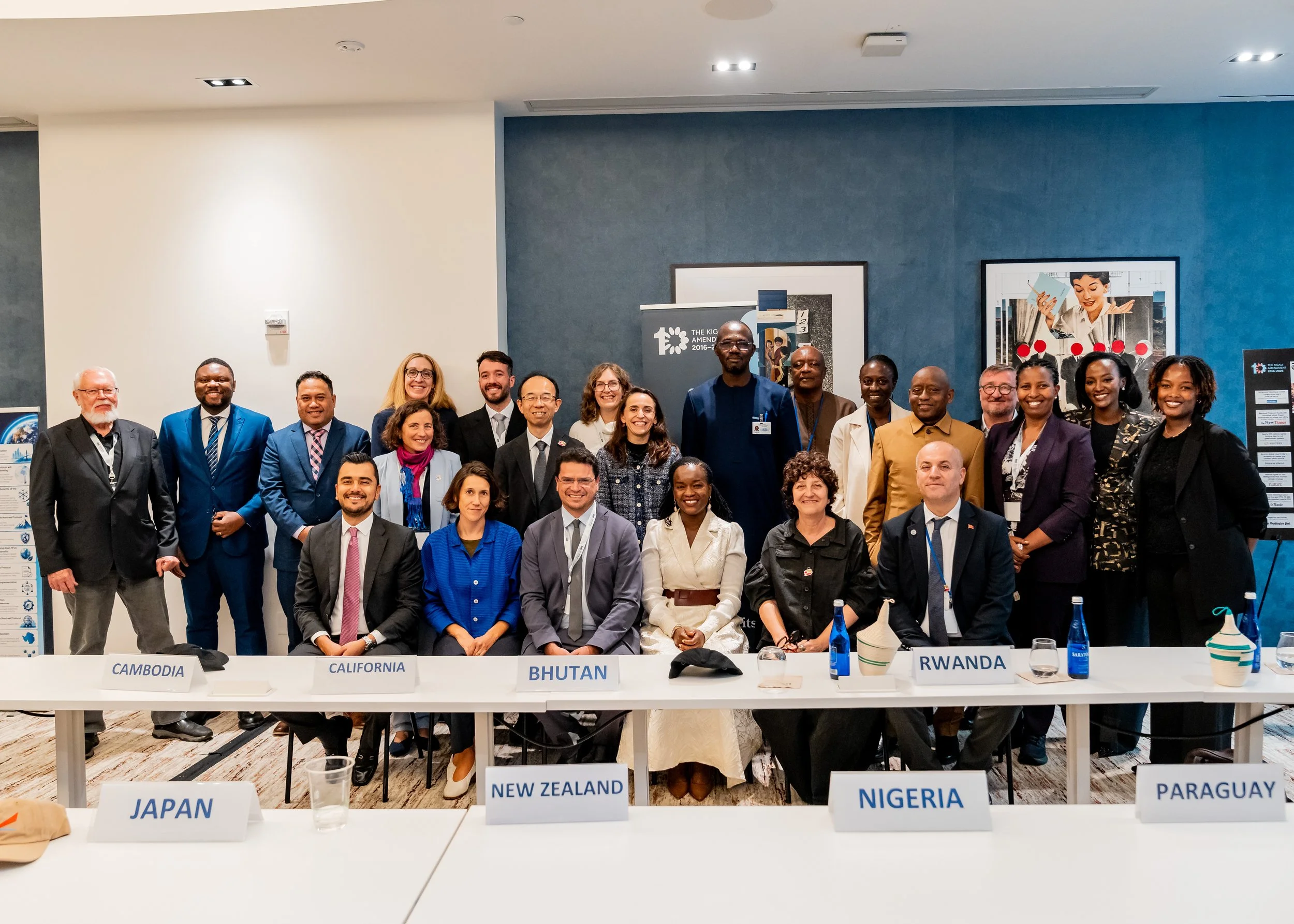
New York City, 23 September 2026 – As world leaders gather in New York for the UN General Assembly and Climate Week NYC, governments today came together to launch the Friends of the Kigali Amendment, reviving the political coalition that helped build support for the landmark climate agreement ten years ago.
The Friends will work to accelerate implementation of the Kigali Amendment and expand access to sustainable cooling, bringing together governments committed to maintaining political momentum and driving practical action over the coming decade.
At the launch, Rwanda, alongside Climate and Clean Air Coalition (CCAC) Co-Chairs Brazil, and the United Kingdom put forward a new Ministerial Communiqué setting out four priorities: strong implementation of the Kigali Amendment; sustainable and energy-efficient cooling and refrigerant management; increased finance, technology and capacity; and renewed industry and partnership.
The Communiqué was an outcome of the New York meeting and provides a platform for further governments to support its priorities. Rwanda, as host of MOP38, and the CCAC, encouraged countries to join the Friends and support the Communiqué as momentum builds towards MOP38 in Kigali and COP31.
“At a time when meaningful climate action has never been more urgent, the Kigali Amendment remains one of the clearest opportunities we have to deliver significant results. Rwanda looks forward to welcoming the world back to Kigali for MOP38, as we celebrate ten years of the Amendment and renew our commitment to its implementation,” said Dr Bernadette Arakwiye, Minister of Environment of Rwanda.
At the Ministerial, major climate philanthropies, including Sequoia Climate Foundation, announced a new joint strategy to accelerate HFC emissions reductions alongside sustainable cooling. They welcomed new efforts by governments ahead of the Kigali Amendment’s 10-year anniversary, called for greater ambition from governments and the private sector, and announced a US$100 million philanthropic funding goal to support these efforts.
"The philanthropic community is mobilizing to support fast action on super pollutants - which account for up to 70% of avoidable warming by 2050 - including making sure we follow the most ambitious and accelerated path for implementing the Kigali Amendment and delivering sustainable, climate-friendly cooling as the world rapidly warms”, said Christie Ulman, President of Sequoia Climate Foundation.
The Kigali Amendment to the Montreal Protocol provides for the phasedown of hydrofluorocarbons (HFCs), powerful greenhouse gases widely used in refrigeration and air conditioning. Its implementation could avoid up to 0.5°C of global warming by 2100. Further climate gains are possible by improving the energy efficiency of cooling equipment as global demand for cooling grows.
The renewed push comes as demand for cooling is growing rapidly. The global stock of air conditioners is projected to rise from 1.6 billion units in 2018 to 5.6 billion by 2050. Access to efficient cooling is increasingly important for food security, hospitals and health systems, vaccine and medicine preservation, digital infrastructure, productivity and resilience to extreme heat.
The Friends will work across three mutually reinforcing areas: phasing down HFCs, improving the energy efficiency of cooling appliances and equipment, and strengthening refrigerant management throughout their lifecycle. They will also seek to mobilise additional public, philanthropic and private finance to complement the Multilateral Fund for the Implementation of the Montreal Protocol.
The Friends builds on the political cooperation that helped make the Kigali Amendment possible. Beginning in 2012, countries working through the Climate and Clean Air Coalition (CCAC) advanced the science on HFCs, demonstrated alternatives, supported national HFC inventories and mobilised high-level political support. From 2014 to 2016, CCAC Ministers worked together to build support for an ambitious global HFC phasedown.
“Ten years ago, countries showed what is possible when political ambition, science and practical solutions come together,” said Martina Otto, Head of the CCAC Secretariat. “The CCAC was proud to help build momentum towards the Kigali Amendment, and the Friends can bring that same spirit to the next decade, accelerating sustainable cooling and delivering benefits for climate, health and development.“
The Friends will meet again in Kigali in November at MOP38 and on the margins of COP31 to review progress, assess commitments and identify further actions to accelerate delivery.
***
NOTES TO EDITORS
Adopted in Kigali in 2016, the Kigali Amendment to the Montreal Protocol established a global phasedown of HFCs. As of August 2026, 174 of the 198 Parties to the Montreal Protocol had ratified the Amendment.
About the Friends of the Kigali Amendment
The Friends of the Kigali Amendment is a voluntary, high-level and action-oriented coalition of governments working to secure the full climate and development benefits of the Kigali Amendment. Led by Rwanda, it is intended to reinforce, rather than duplicate, the institutions and processes of the Montreal Protocol.
About the Climate and Clean Air Coalition (CCAC)
The Climate and Clean Air Coalition (CCAC) is a voluntary partnership of governments, intergovernmental organizations, businesses, scientific institutions and civil society organizations committed to improving air quality and protecting the climate through actions to reduce short-lived climate pollutants. Its global network includes hundreds of state and non-state partners, and hundreds of local actors carrying out activities across economic sectors. CCAC is also the Secretariat to the Global Methane Pledge. The CCAC Secretariat and Trust Fund are hosted by UNEP.
For more information, please contact:
Basile Uwimana, Communications and Outreach Specialist, Ministry of Environment:
Vincent Hughes, Communications and Media Consultant, Climate and Clean Air Coalition Secretariat at United Nations Environment Programme: Vincent.Hughes@un.org.
Ava Bahrami, Communications Officer, Climate and Clean Air Coalition Secretariat at United Nations Environment Programme: Ava.Bahrami@un.org
View photos of the event.